 |
 |
Adelfes tsugae Description: Hemlock woolly adelgid is an aphid-like insect native to Japan. In the 1920’s it was discovered in the Western U.S., however the hemlock there seems to be resistant. It wasn’t until the 1950’s that hemlock woolly adelgid began its reign of destruction. It was discovered in Virginia, feeding on Tsuga canadensis. Presently hemlock woolly adelgid infestations extend from North Carolina to Massachusetts and continue to spread at a rate of 20-30 km each year. The adelgid feeds on the base of the needles, causing desiccation, bud mortality, and branch and tree mortality within four years. Trees infected with hemlock woolly adelgid are recognizable by the white woolly ovisacs found at the base of the needles and by the grayish green color of the needles. Several natural predators of hemlock woolly adelgid are being researched as possible bio-control agents; the ladybird beetle (Pseudoscymnus tsugae) and the oribatid mite. The ladybird beetle is extremely successful in containing population numbers in Japan, where is accounts for 90% of hemlock woolly adelgid mortality. It is possible to treat individual trees with a pesticide, however this is not practical for treating large areas. 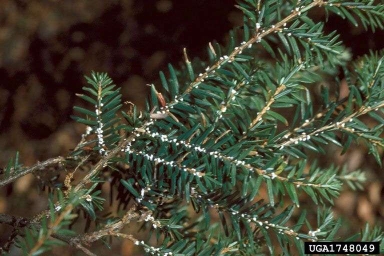 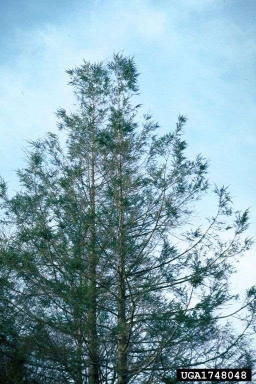 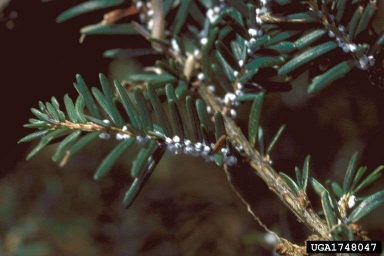 white woolly masses, damage and woolly masses images 1,2 & 3 by Robert L Anderson, USFS - forestryimages.org Quick Guide (single page info sheet in pdf format) Selected Publications: Cheah, C.A. S-J. and M.S. McClure. 1998. Life history and development of Pseudoscymnus tsugae (Coleoptera: Coccinellidae), a new predator of the hemlock woolly adelgid (Homoptera: Adelgidae). Environmental Entomology 27:1531-1536. Orwig, D.A. and D.R. Foster. 1998. Forest response to the introduced hemlock woolly adelgid in southern New England, USA. Journal of the Torrey Botanical Society 125:60-73. Wallace, M.S. and F.P. Hain. 2000. Field surveys and evaluation of native and established predators of the hemlock woolly adelgid (Homoptera: Adelgidae) in the southeastern United States. Environmental Entomology 29:638-644. Links: |
 |
| School of Forest Resources and Environmental Science Michigan Technological University 1400 Townsend Drive Houghton, MI 49931 (906) 487-3470 ces@mtu.edu |
Copyright © 2002-2003 Center for Exotic Species (CES) image credits |